01
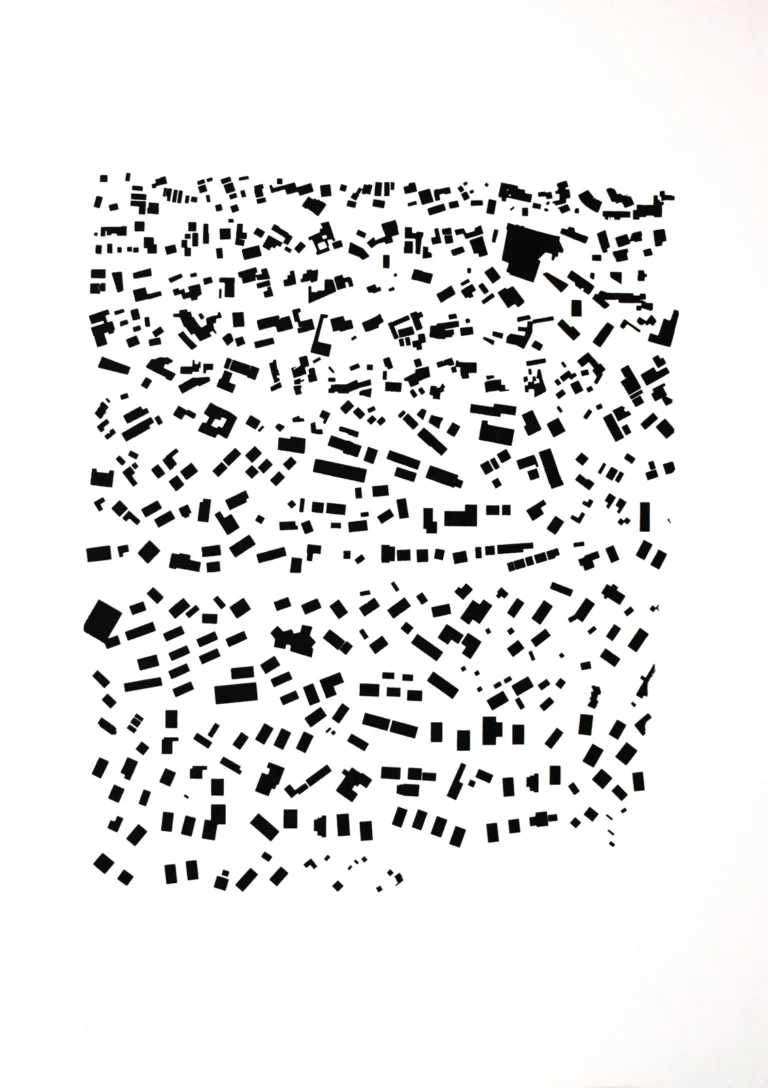
Simona Boccardi
Sradicati, 2024
Screen print · 35 × 50 cm
Opening exhibition
Exhibition · closed
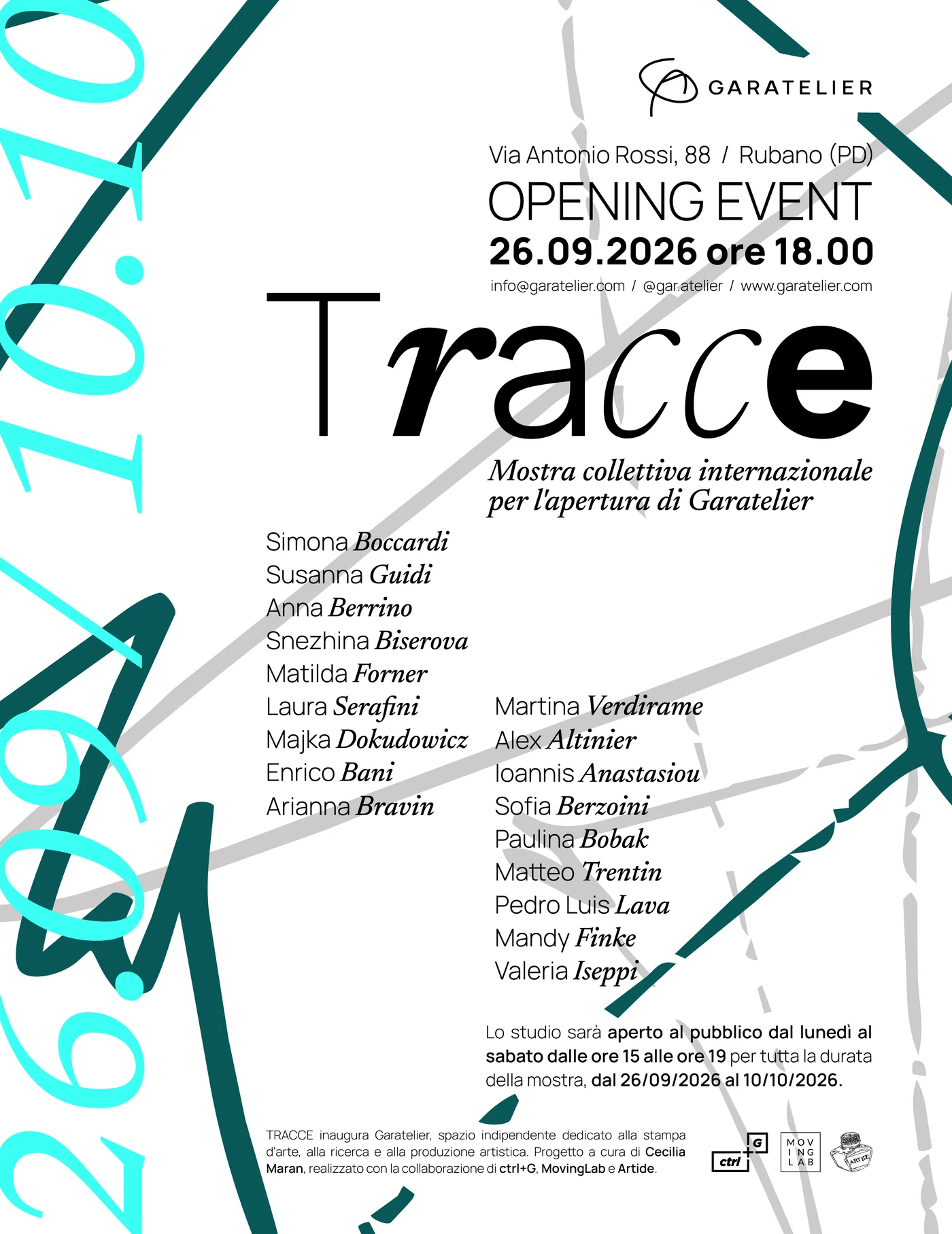
26 September 2026, 6 pm
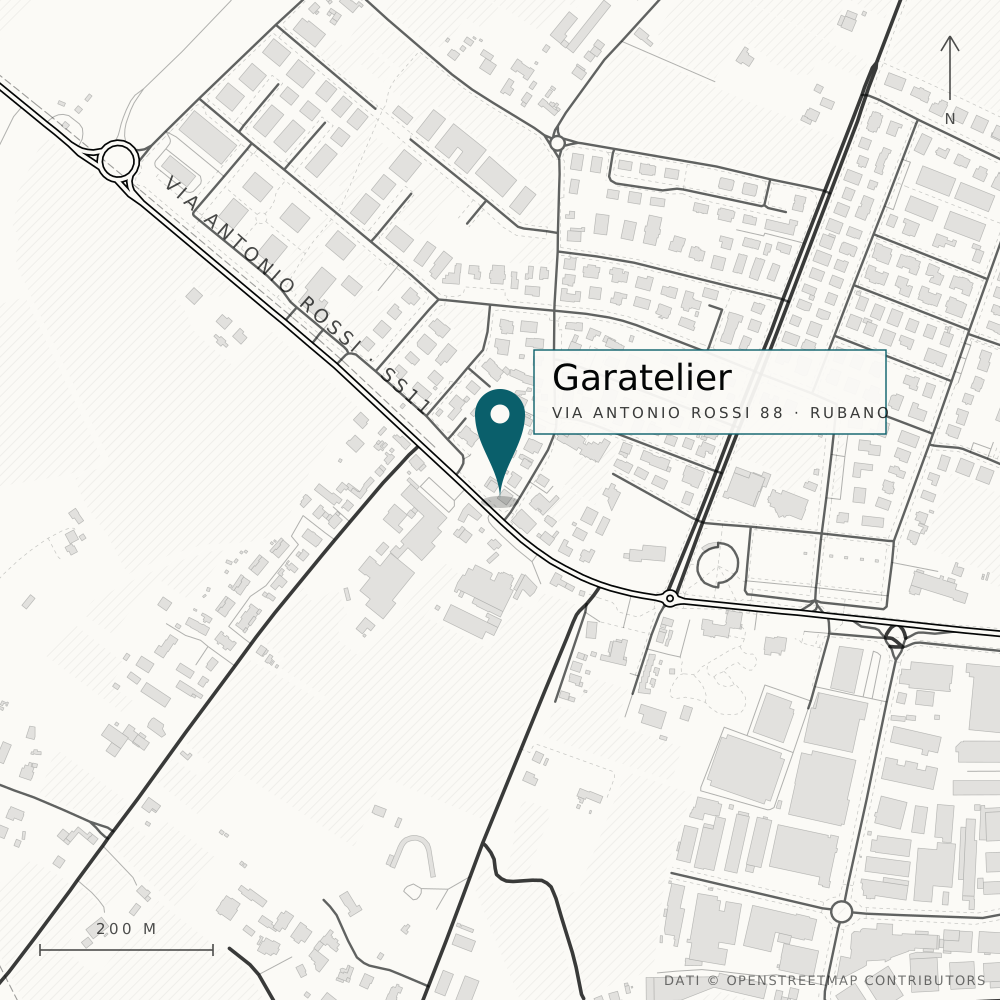
Rubano (PD) · Via Antonio Rossi 88 · Free entry
Garatelier’s first open call. The chosen works made up the exhibition with which the space opened to the public.
/The exhibition
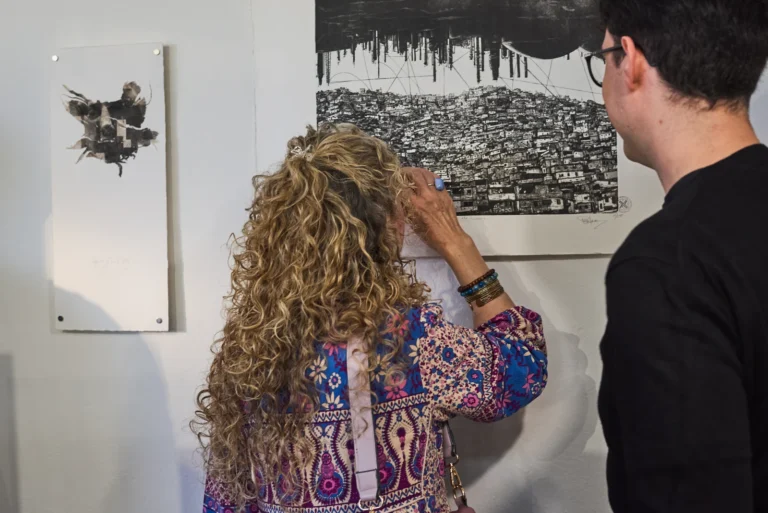
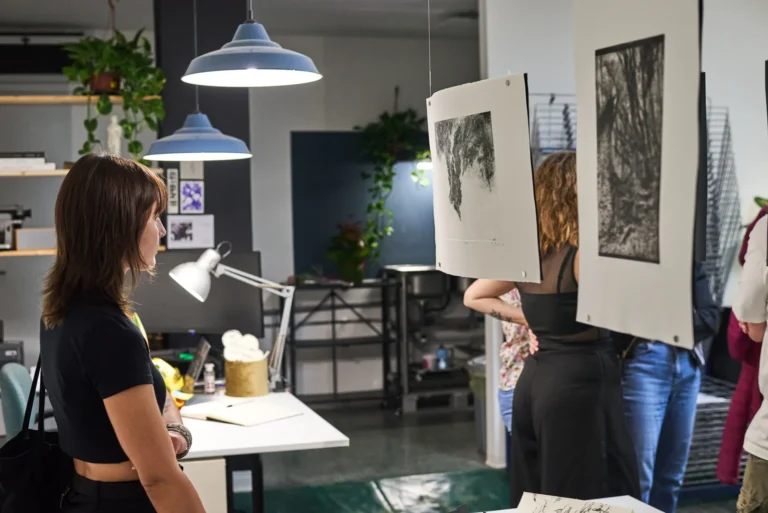
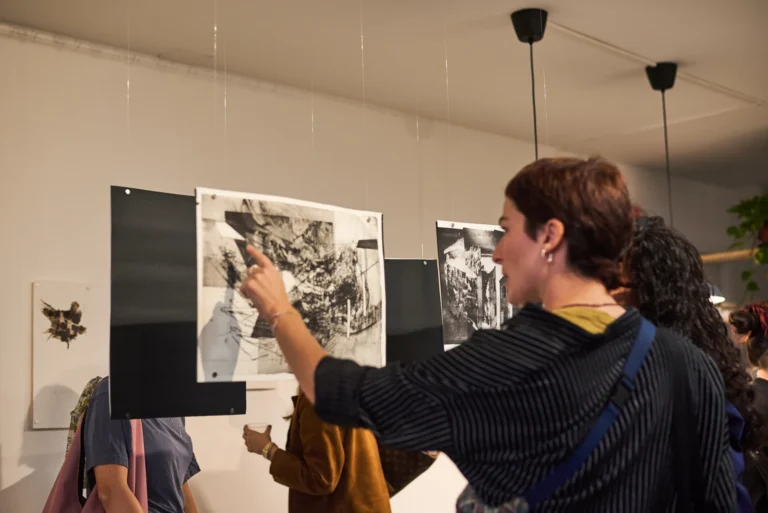
Garatelier opened to the public on 26 September 2026, at via Antonio Rossi 88 in Rubano, with the group exhibition «Tracce», on the walls until 10 October. It was the first time the workshop had opened its doors, and the works came from the first international open call the studio had run. The exhibition is curated by Cecilia Maran, in collaboration with CTRL+G, MovingLab Venice and Artide.
It all started from a word. In printmaking the trace is the craft itself: the mark the needle leaves in the zinc, the bite the acid opens in the plate, the pressure of the press that passes the ink to the paper. Every sheet is the trace of a plate, and the plate is the trace of a gesture. Every place keeps the traces of those who pass through it. We asked for a work that documented a journey, a transformation, a memory, a piece of research under way, in any printing technique and in any form.
Submissions closed on 26 August: 123 of them, from all over the world. They were read by a jury of different trades — people who etch and print, people who curate exhibitions and follow emerging artists, people who teach, people who work on strategy and design. Every entry passed under all of these eyes.
On the jury: Cecilia Maran, founder of Garatelier; Alice Pianta, artist and printmaker; Roberta Feoli De Lucia, artist, printmaker and educator; Giorgia Munaron and Vittoria Mastrolilli, of MovingLab Venice; Giulio Beccegato, of CTRL+G.
From the 123 entries the jury chose 18 works. They cover a good part of printmaking today: etchings, aquatints and drypoints, a mezzotint, screen prints and a risograph, a laser-engraved plate, an artist’s book to leaf through, editions that become objects and boxes. Single sheets and compositions of several elements, on show at Garatelier from 26 September to 10 October. The catalogue is on its way: it will be available to browse as a PDF and to buy on Amazon.
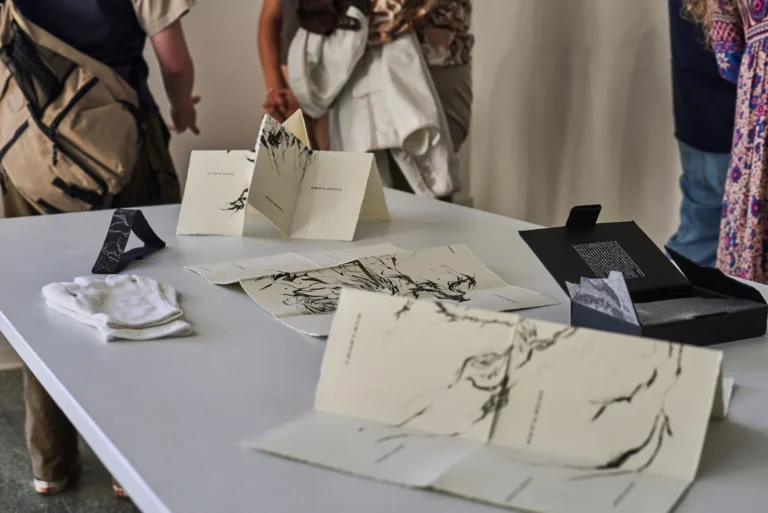
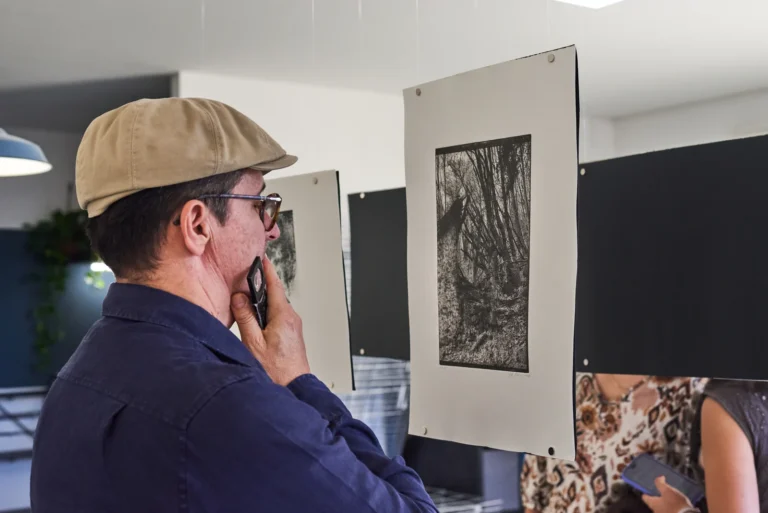
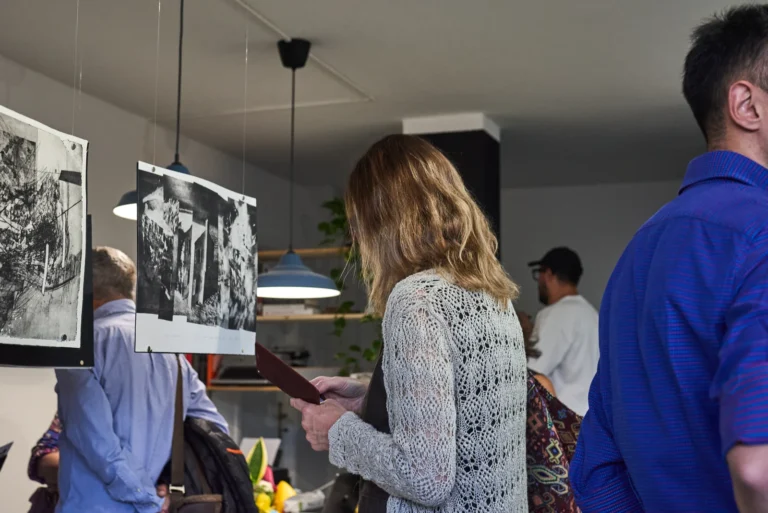
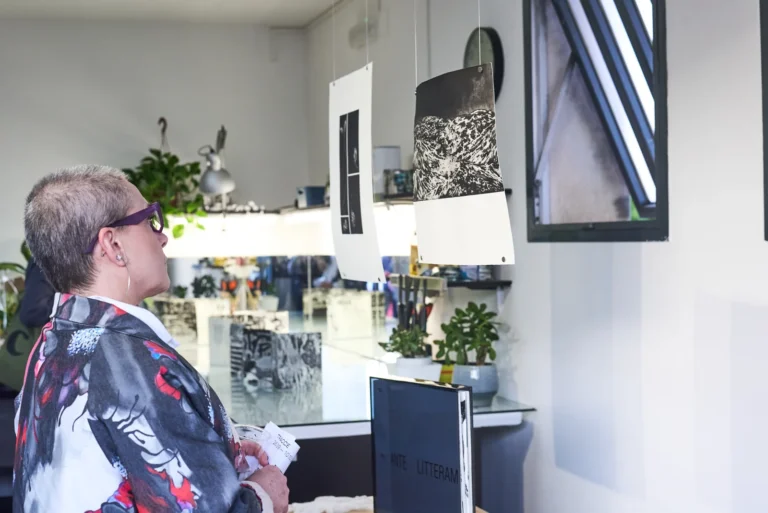
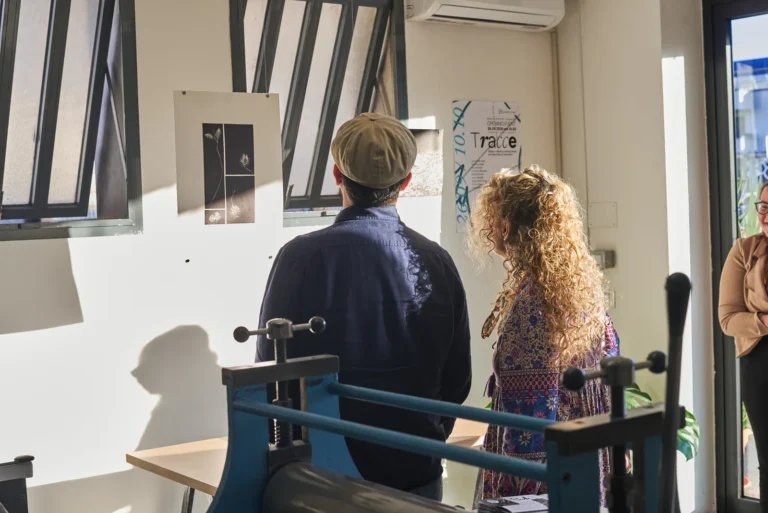
The works hung without frames and without glass, at eye level, so the paper could be seen up close, in its grain and in the relief left by the press. Some sheets came down from the ceiling in the middle of the room, the artist’s book was leafed through with white gloves, and the press stayed where it is, among the works. At the centre of it all was the mark, analogue or digital.
Dintorni, the magazine on art and design in the Veneto, interviewed Cecilia about how Garatelier began and about «Tracce». Read it in the Journal→
Thanks to CTRL+G and to MovingLab Venice, who supported the open call and read the entries alongside us, and to Artide, who worked alongside Garatelier on the exhibition. And thank you to every artist who sent their work from around the world: 123 entries for a studio that had yet to open its door. They told us, before anyone else, that this path made sense.
/The selected artists
01
Sradicati, 2024
Screen print · 35 × 50 cm
01 / 18Simona Boccardi
/The work
/The artist
Simona Boccardi (Foggia, 2001) is an artist from the Subappennino Dauno. After starting out at a science high school, she changed direction and trained in art at the Academy of Fine Arts. Drawn at first to graphic art, over time she moved towards the visual arts, in a constant search for languages that allow her to build an authentic, personal vision.
I love the essential, the kind that has no need to raise its voice. I believe in simple gestures, in small shifts that can tell of complex worlds. My work is often born in silence, where themes of identity, childhood, the land and community come to the surface. I am not looking for definitive answers, but for images that stay open. In the folds of everyday life, I keep looking for forms to tell what is overlooked.
/About the work
What is left of being deprived of one’s place? What is left of a place deprived of those who live in it?
I reduced the buildings to pure geometric forms, a gesture that reveals an ontological gap between form and content. In that elementary volume lies the whole thickness of living together: genealogies, conflicts, overlapping eras, languages and flavours handed down. Geometry, silent in appearance, is writing: it is history, it is a person.
Moving those buildings, taking them away from their original context, is not a neutral gesture: it is an ontological act. In their original setting they bear witness to a community; elsewhere, they remain a mere outline, a shell without a voice.
The same happens to those who emigrate: they are altered, they lose a part of themselves, their territorial identity. The abandoned place empties of meaning, like a bereavement.
The work comes from an autobiographical urgency: those buildings are Bovino, the medieval village near Foggia where I was born, which has emptied over the years.
Artist’s text, translated from Italian.
02
Maps, 2024
Etching and drypoint · print 30 × 40 cm
02 / 18Susanna Guidi
/The work
/The artist
Susanna Guidi (Lucca, 1999) studied at the Academy of Fine Arts in Carrara, where she took her bachelor’s degree in Printmaking. Her research currently focuses on the body and the skin, and on their close bond with pain and memory, weaving her personal experience into art-historical and philosophical study. The body, and the idea of the “surface” that contains it, are seen and lived by the artist as a place of conflict and an ideal territory for a phenomenal reality. During her years at the academy, bringing together her own experience and her interest in philosophy, she explored the theoretical and expressive sides of her research through printmaking, later extended to other techniques.
/About the work
Maps focuses on the extraordinary ability of the human body, and of the hand in particular, to hold and reflect a person’s past, present and future.
The practice of chirology and palmistry meets the rich weave of each individual’s life experiences, offering a powerful tool for understanding a person’s path and destiny over the course of their existence. The lines of the hand, constantly changing, act as keepers of memories and lived experience, turning into a complex map that can be hard to read, for others as much as for ourselves.
The skin, as keeper of time, absorbs and preserves the imprints of our lives: scars, marks and traces that tell stories of joy and pain. It is a tangible record of our experiences, a place where every detail, however forgotten by the mind, lives on in the body.
Artist’s text, translated from Italian.
03
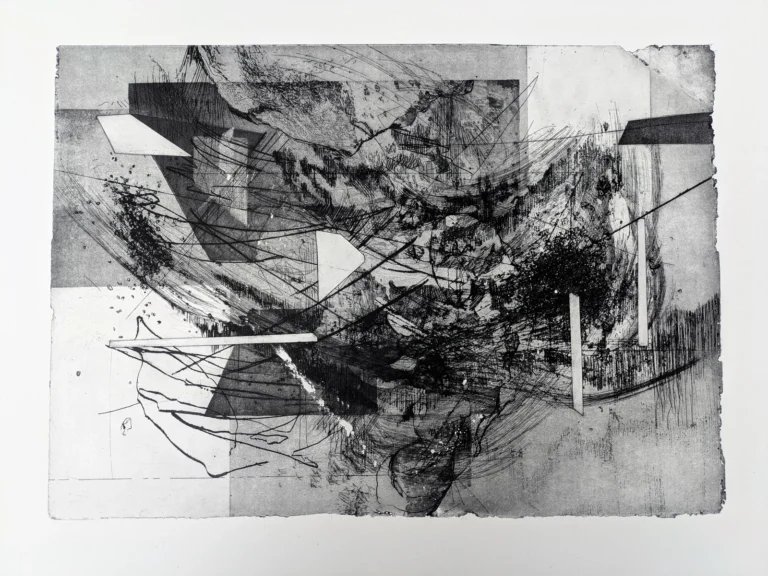
Campo di Forze, 2026
Etching · 35 × 50 cm
03 / 18Anna Berrino
/The work
/The artist
Anna Berrino is a visual artist based in Florence. Her practice moves between expanded printmaking and site-specific installation, exploring the intersections of landscape, materials and processes. After training at Edinburgh College of Art, she specialised in printmaking at the Fondazione Il Bisonte. She has exhibited internationally and her work is held in public and private collections. In 2026 she won the Calco printmaking biennial.
/About the work
The work comes from my practice of walking in the landscape and from reflecting on the philosopher Timothy Morton’s idea of landscape as a space of co-belonging: not a neutral backdrop to observe or depict, but a system of relations in which the human is involved and by which it is continually changed.
Seen this way, the landscape does not appear legible or harmonious, but as a complex field of interactions between human practices, animal dynamics and environmental processes. The loss of legibility in the image is not an aesthetic effect but a stance: it switches off a gaze that looks for a stable form in the land, and gives the land back instead as a process under way, one that calls for new ways of reading and of responsibility.
The plate was made using several techniques: etching, aquatint, drypoint and salt ground. It went through repeated bites and phases of erasing, abrading and re-etching, dictated by my movements, pauses and encounters. The result is a layered surface in which the mark is not only drawn but is accumulation, loss and transformation. It is a temporary, layered mark that tells of a relationship rather than an image.
This print is part of a series on mountain ecology and artistic practice, and took shape during periods of research in Alpine settings.
Artist’s text, translated from Italian.
04
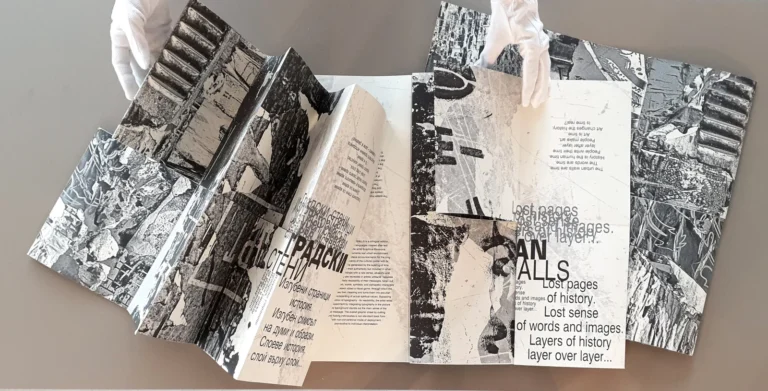
Urban Walls, 2020
Artist's book · 25.3 × 19.5 × 3 cm
04 / 18Snezhina Biserova
/The work
/The artist
Born 1962, Sofia.
1988: M.F.A. in printmaking at the National Art Academy in Sofia.
2006–2024: National Art Academy of Sofia, lecturer in the “Book and Printed Graphics” Department.
Professor at Sofia University “St. Kliment Ohridski”, Faculty of Educational Studies and the Arts, “Visual Arts” Department, since 2024.
She has taken part in many national and international group exhibitions and art projects and has had 16 solo shows in Bulgaria and Poland. She is the recipient of national and international art honours. Her works are held in public and private collections in Bulgaria and abroad.
Member of the Union of Bulgarian Artists, associated with UNESCO, since 1991; of the Associazione Nazionale Incisori Italiani APS, Vigonza (Padua), Italy, since 2021.
/About the work
The artist’s book “Urban Walls” is a bilingual art edition in Bulgarian and English, using the author’s writings and images. The graphic material depicts a real urban setting, with time and location announcements for long-ago and forgotten events from the cultural agenda, which has a natural predisposition for disorder and consumption.
Overlaid collages, formed over time, are kept in their authenticity while being drawn into various connotative interactions, charged with new meanings, allusions and interpretations, and replicated in creative artefacts. Separated phrases and symbols, displayed outside their original context, create a visual play in which I re-encode their meanings into unique accents. By integrating the typography into the image, I partly bypass its main role: readability.
05
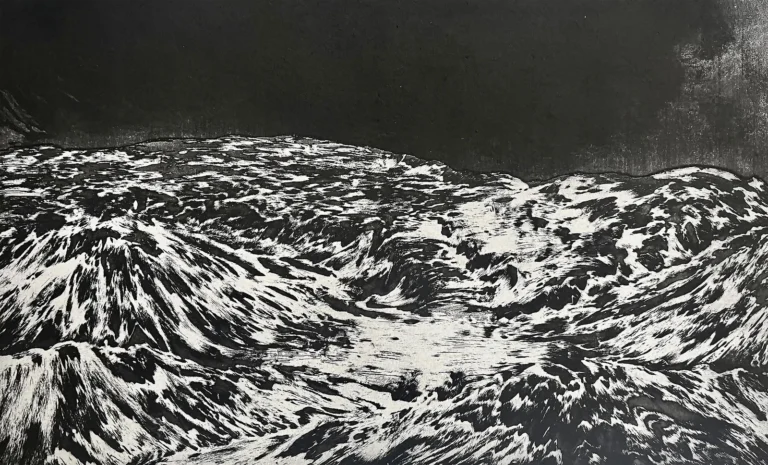
Silentium grave, 2026
Etching · 35 × 42.5 cm
05 / 18Matilda Forner
/The work
/The artist
Matilda Forner (Padua, 1997) took her first-level diploma in Painting at the Academy of Fine Arts in Venice in 2020 and, in 2024, her second-level diploma in Printmaking and Drawing at the same school. That year she was awarded a scholarship for the one-year course in Etching and Fine Art Printing at the Fondazione Il Bisonte – Scuola per lo Studio dell’Arte Grafica in Florence. In 2025–2026 she worked there as assistant in the letterpress workshop, devoting herself to research into etching and fine art printing.
/About the work
A mountain landscape, remote and severe, opens onto a suspended dimension, where the presence of the mountains evokes a sense of deep solitude and silence. The forms, immersed in an almost motionless atmosphere, seem to hold an ancient memory, of which only silent traces remain, far from any human presence. Traces that do not necessarily tell of a passage, but suggest what time has left imprinted on the landscape. What arises is a feeling of estrangement and recollection, like standing before something immense and indecipherable. The landscape does not describe a precise place but an inner state: an intense stillness, crossed by a feeling of distance, memory and mystery.
Artist’s text, translated from Italian.
06
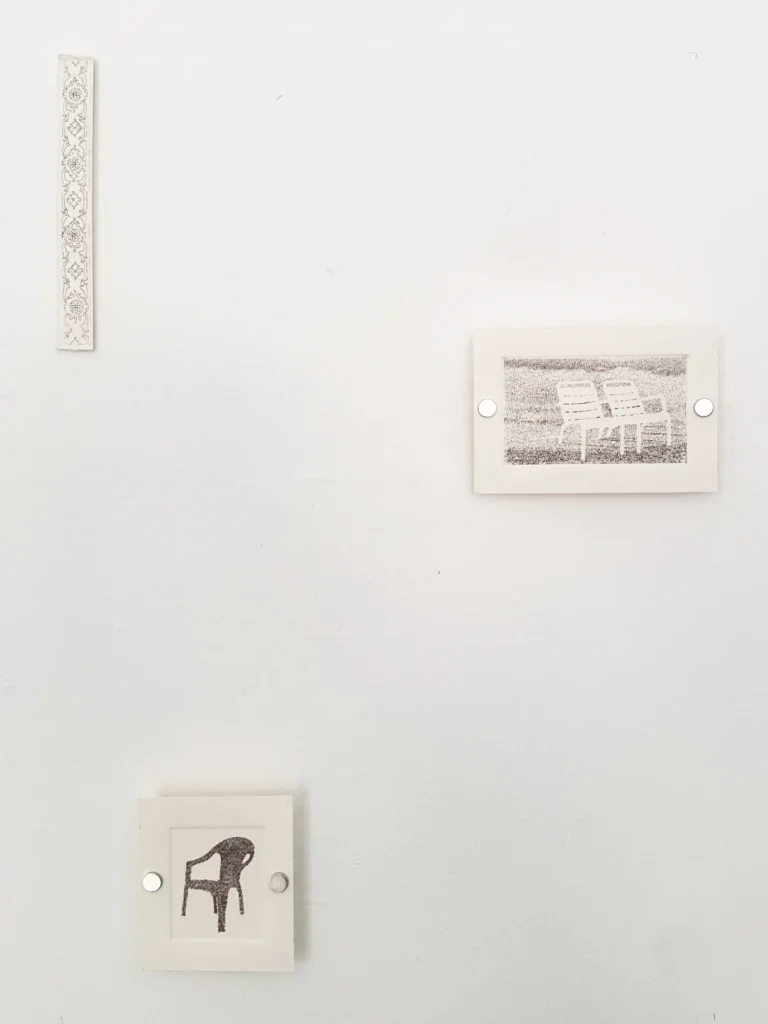
Posarsi, 2026
Etching on zinc · 50 × 35 cm
06 / 18Laura Serafini
/The work
/The artist
Born in Bolzano in 2000, I live between Milan and Bolzano. In 2024 I graduated in Printmaking at the Brera Academy of Fine Arts, where I am now taking the master’s course in the same subject. I went to the Giovanni Pascoli art high school, spending a year abroad in Wales, where I studied Fine Arts. My work explores memory, above all personal experience and nostalgia. I use techniques drawn from printmaking, drawing and photography, all linked to my studies.
/About the work
Posarsi brings together on one sheet moments and places far apart. The paper becomes a shared space, a meeting place for scattered memories. Three plates for three instants: a flourish found in Portugal, two chairs on the lakeshore in Lugano, and a chair come across in a park in Milan. Through the practice of mark-making, these images let me take back the memory that keeps slipping away from me, bringing back to light these moments of which only traces remain.
Artist’s text, translated from Italian.
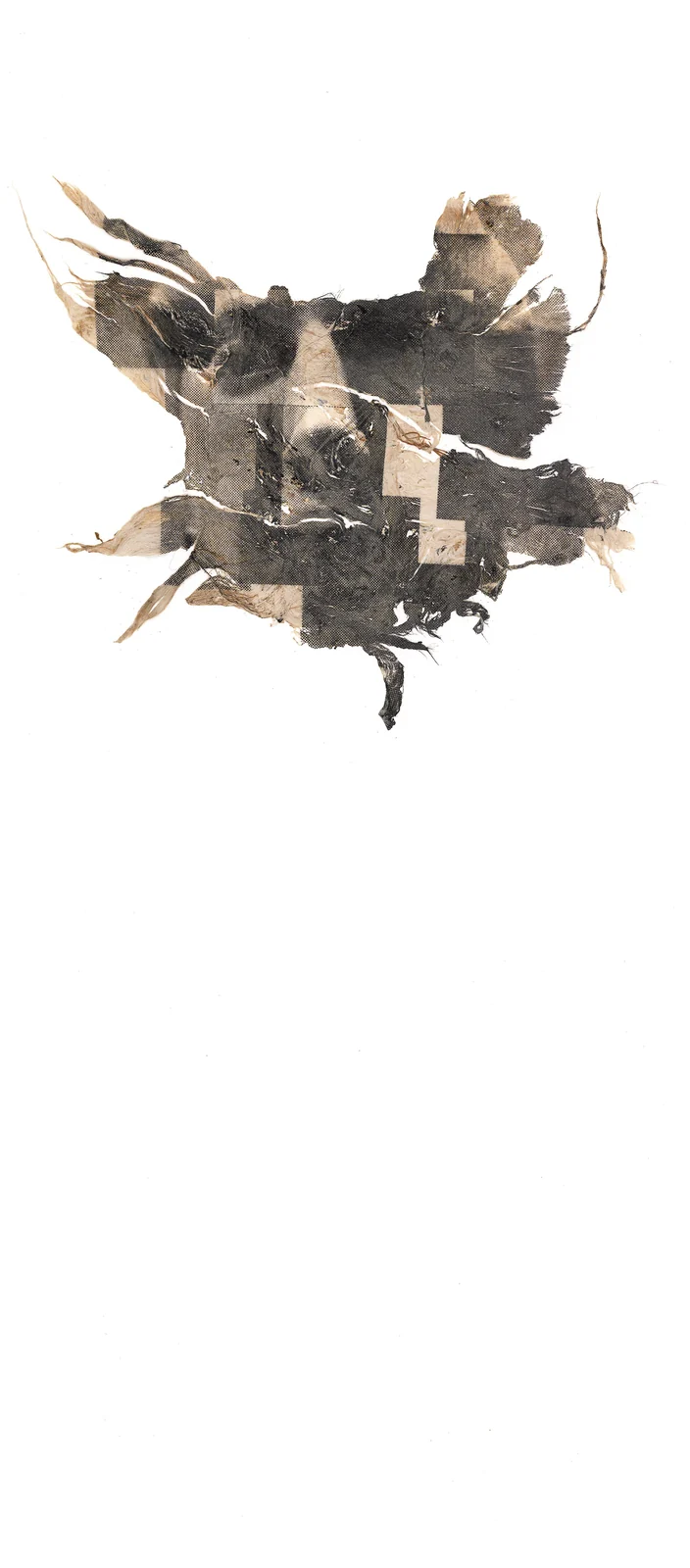
07
Infinite Fragments, 2025
Screen print on plant fibre · 50 × 25 cm
07 / 18Majka Dokudowicz
/The work
/The artist
Born in Warsaw, Poland, in 1990. She works at the E. Geppert Academy of Fine Art and Design in Wrocław, where she received her PhD in printmaking. She also holds a BA in Culture Studies. She is a printmaker, bookbinder and papermaker, and co-founder of Misprint Studio.
She has attended residencies in Germany, Spain and the USA. She has been recognised with numerous awards in international competitions, including the Grand Prize at the X Intercontinental Small Graphic Biennial in Aiud, 2nd Prize at the 12th International Biennale of Miniature Art in Częstochowa and the Prize of Excellence at the 8th NBC MESHTECH Tokyo International Screen Print Biennial. She has exhibited in more than 200 shows worldwide.
/About the work
In this work I examine what is fragile and incomplete, hovering between presence and absence. I work with ruin as a process that occurs ceaselessly – in matter, in print, and in the gaze. The fragment becomes a form of duration, offering simultaneous insight into the past and the future. What remains is not simply a remnant, but a trace – a mark of something that was present and is already disappearing. In this context, the portrait becomes a way of thinking about a person and their transience: an image that does not preserve, but conceals. The image does not merely depict ruin but becomes a manifestation of it – an experience of the gaze that reveals and simultaneously destroys. This is also how I understand my work with prints and with the fibre I prepare myself. The works are not an attempt to reconstruct the whole, but an act of coming to terms with the impossibility of doing so. They remain as traces – records of a presence that can never be fully recovered.
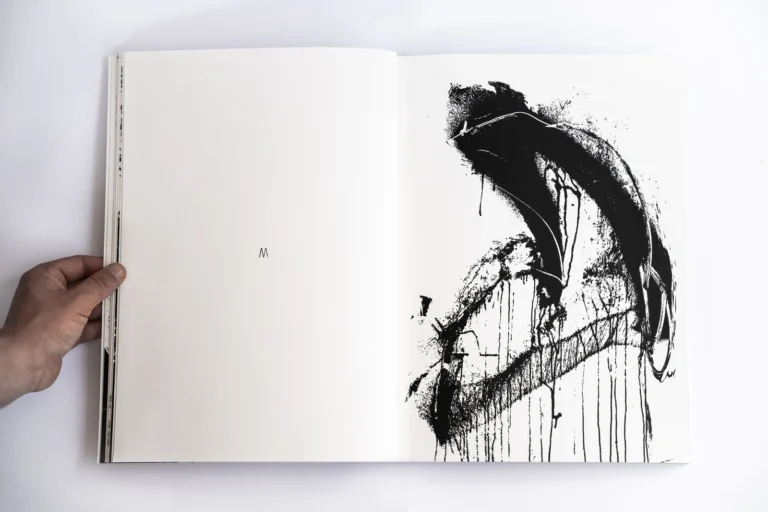
08
ANTE LITTERAM, 2024
Screen print · 29.8 × 36.5 × 4 cm
08 / 18Enrico Bani
/The work
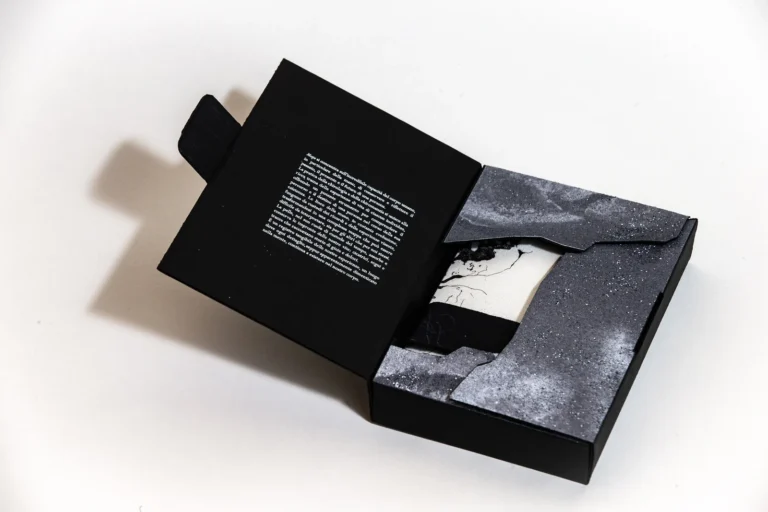
In the exhibition it can be handled, wearing white gloves.
/The artist
Enrico Bani (Pisa, 1996) studied Printmaking at the Academy of Fine Arts in Carrara, where he took his bachelor’s and master’s degrees. He spent an Erasmus period at the Academy of Fine Arts in Warsaw. He is currently a trainee at DruckWerk and Quint Screen Print in Vienna. His work has been shown in museums, galleries and international printmaking prizes in Italy and across Europe.
/About the work
ANTE LITTERAM gathers the traces of past research and of a moment of transition towards a new reality and a new language. It brings to light what came before writing, searching for the mark and the form hidden within language. The art edition becomes object, container and work, able to hold and make visible marks, forms and materials. Through their modular composition and layering, a shifting, a-signifying alphabet emerges, one that asserts itself as writing drifts and opens the way to a new language: the anti-language.
Artist’s text, translated from Italian.
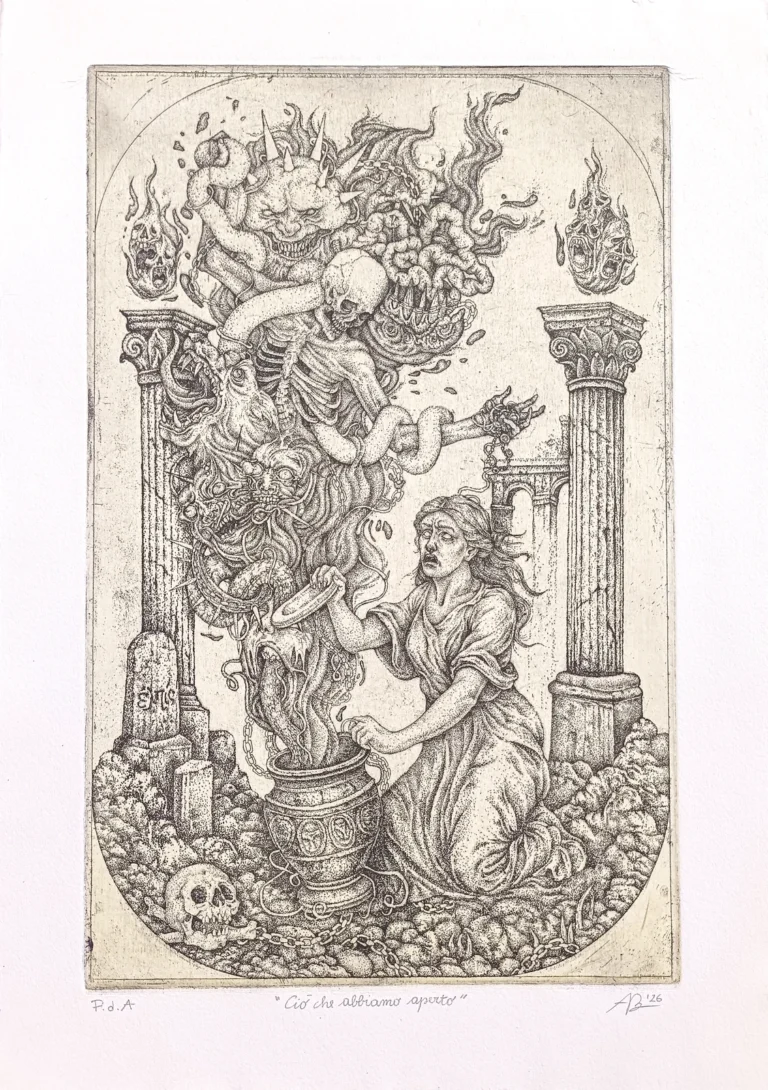
09
Ciò che abbiamo aperto, 2026
Etching · sheet 35.5 × 25 cm
09 / 18Arianna Bravin
/The work
/The artist
Arianna Bravin, born in Motta in 1999, is an artist and illustrator. She studied at the Academy of Fine Arts in Venice, where in 2025 she took her master’s degree in Printmaking and Drawing with 110 cum laude.
Her research focuses mainly on intaglio printmaking, with a particular love for etching, alongside an interest in traditional and digital illustration. Her work unfolds through metaphorical and symbolic images, in which traditional depictions and iconographies are reworked in relation to contemporary themes and to the psychological and personal sphere. In 2022 she contributed the etchings “La libertà” and “Vivere ardendo” to the volume “Gaspara Stampa, Poi che m’hai resa Amor la libertade” (Eidos Editore).
In 2023 she was selected by the Venetian District for Research and Innovation for the exhibition “Antropocene. La Terra a Ferro e Fuoco” in Venice, with the etching W.A.T.K – We Are The Key. She won the 9th Rotary Arte e Cultura Venezia prize with the illustration Save the Water. In 2025 she took part in the “Impronte del Borgo” residency in Cison di Valmarino, organised by the Associazione Nazionale Incisori Contemporanei.
/About the work
The work shows the suspended instant in which Pandora opens the jar and releases into the world what had until then been held back. The scene, in its composition and choice of figures, deliberately recalls a classical, almost ancient imagery, but its meaning shifts towards a deeply contemporary reflection.
Pandora’s gesture becomes a metaphor for what happens when something is opened, revealed or set in motion: a choice, a curiosity, a desire can have consequences beyond our control. What comes out of the jar does not disappear; it crosses space, settles and leaves marks. The evils of the myth thus become images of the fears, fragilities, conflicts and unease of people today, but also of the consequences our actions can leave on the world.
“Ciò che abbiamo aperto” – what we have opened – therefore tells of an irreversible moment: the one in which an individual gesture stops belonging to us and becomes part of a larger story, leaving a trace behind it.
Artist’s text, translated from Italian.
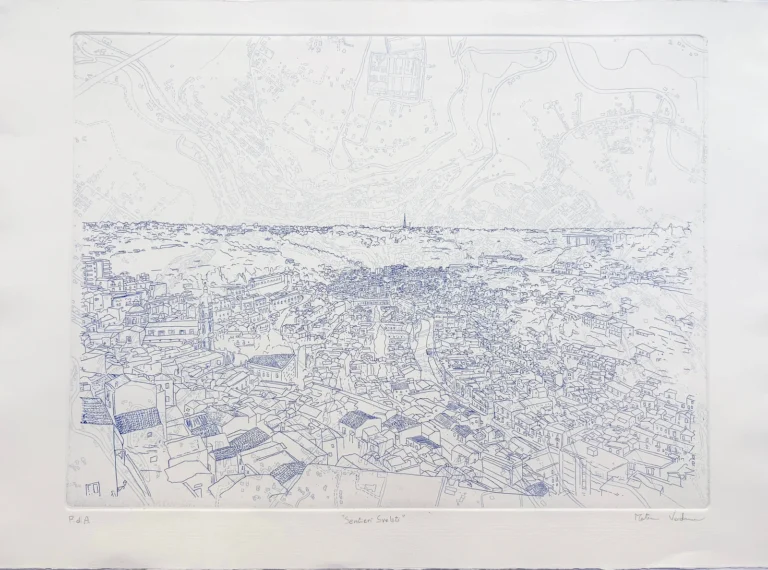
10
Sentieri Svelati, 2026
Soft-ground etching and etching · 35.5 × 50 cm
10 / 18Martina Verdirame
/The work
/The artist
I am Martina Verdirame, born in Sicily in 2003. After the art high school in Modica, I went on to the Academy of Fine Arts in Venice, where I took my first-level diploma in Printmaking. I am now on the two-year course in Printmaking and Drawing.
I have always had a passion for drawing and photography, joined in recent years by an interest in printmaking. My research focuses on landscape, above all the lands of Sicily, Modica in particular, and of Venice, which I explore with a personal eye, using the landscapes I depict to tell the history and the memories that bind me to the places I have lived in.
/About the work
«Sentieri velati da un tratto eterno: basole tra scorci di storica passione; a passi tardi rinvengo in cor mio nascituro sguardo che soave m’attrista.» Salvatore Quasimodo
A visual journey through Modica, where different traces, perspectives and layers meet in a continuous dialogue. A story of glimpses, memories and architecture that gives back the most authentic essence of the city.
In this work two different traces, made on two plates with different techniques, come together in a single print. The first shows part of the map of Modica; over it lies a second, with part of the city’s landscape. This reveals some of the paths that the map does not show, and that tell of history, memories and traditions.
Artist’s text, translated from Italian.
11
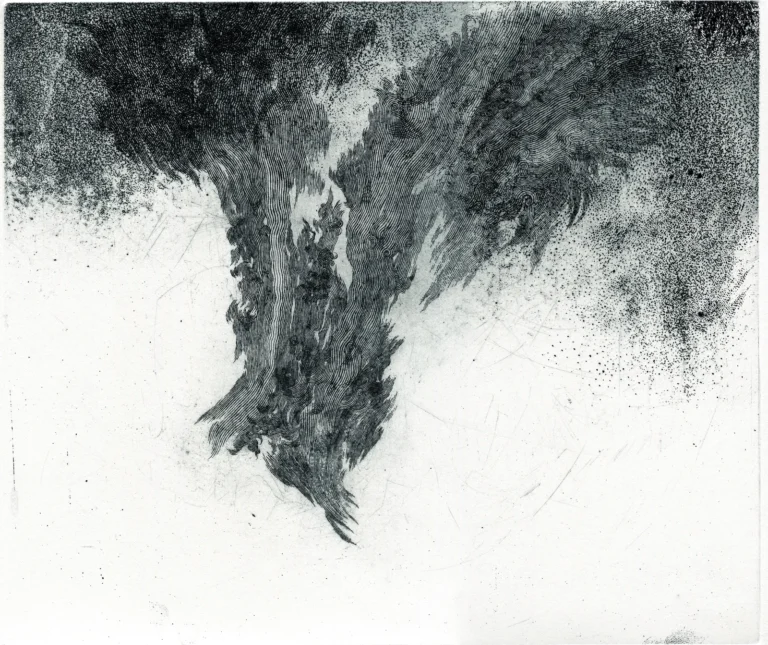
Soffio, 2026
Etching · 35 × 50 cm
11 / 18Alex Altinier
/The artist
Alex Altinier was born in 1993 in Vittorio Veneto (TV). In 2020 he took his master’s degree in Printmaking at the Academy of Fine Arts in Venice, specialising above all in etching and in the anatomical study of the human body.
He now prints on his own and at the etching workshop of the Xinciso arts and culture association in Vittorio Veneto.
/About the work
Soffio – breath – is part of a series of drawings and prints whose subjects escape any fixed classification.
The forms are unstable and live in different slices of time, in which they surface or return to their potential state.
Seen up close, this energy made of marks and dots offers spiralling, plant-like elements: whirling motions of fluids and currents of air.
Artist’s text, translated from Italian.
12
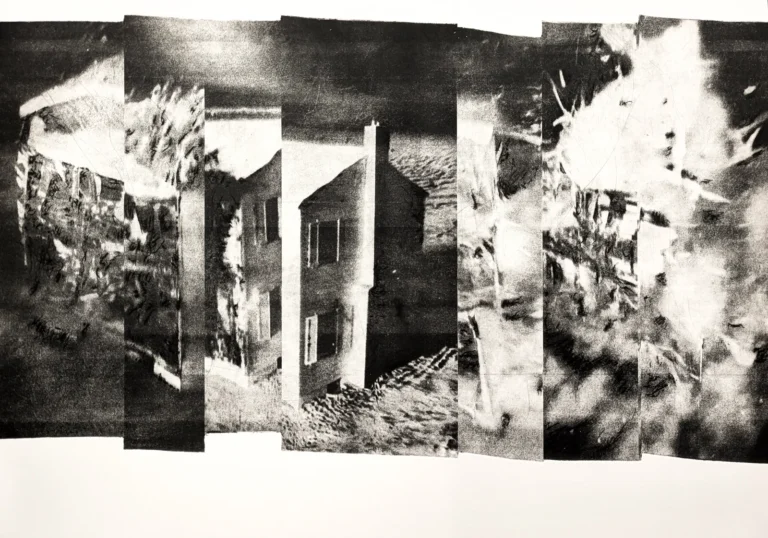
Seven Stops Before the End, 2026
Intaglio from a laser-engraved plate · 35 × 50 cm
12 / 18Ioannis Anastasiou
/The work
/The artist
Born in 1995 in Athens, Greece.
He lives and works in Wrocław, Poland, and is currently employed at the E. Geppert Academy of Art and Design in Wrocław. He is the co-founder of Misprint in Wrocław.
He received his PhD in Art from the E. Geppert Academy of Art and Design in Wrocław in 2023, and his Master’s Degree in Printmaking from the School of Visual and Applied Arts, Faculty of Fine Arts, AUTh. His work includes social and political contexts. He uses relief, intaglio, planographic and experimental printmaking techniques to create 3-D objects, installations, artists’ books and prints.
He has received multiple awards and distinctions and has exhibited in more than 120 international exhibitions and competitions. His works belong to various public and private museum collections. He has taken part in international conferences, symposiums, workshops, art publications and journals. He is a co-organiser of PrintCard Wrocław – International Prints Exchange.
/About the work
The work “Seven Stops before the End II” is an experiment belonging to the ongoing creation of a series of works under the working title “A Few Stops Before the End”. The series uses archival public-domain material from the 19th and 20th centuries, heavily distorted with different scanning and assembling techniques. The matrices are printed as intaglio prints: the plate is laser-engraved on plastic, with the addition of drypoint.
Seven Stops Before the End II takes a famous sequence of pictures from Knothole Annie, unites them and reinterprets them as a single picture. The series explores destruction, death, humanity’s flirtation with “the end”, through the traces of our recent collective past: war, and loss.
13
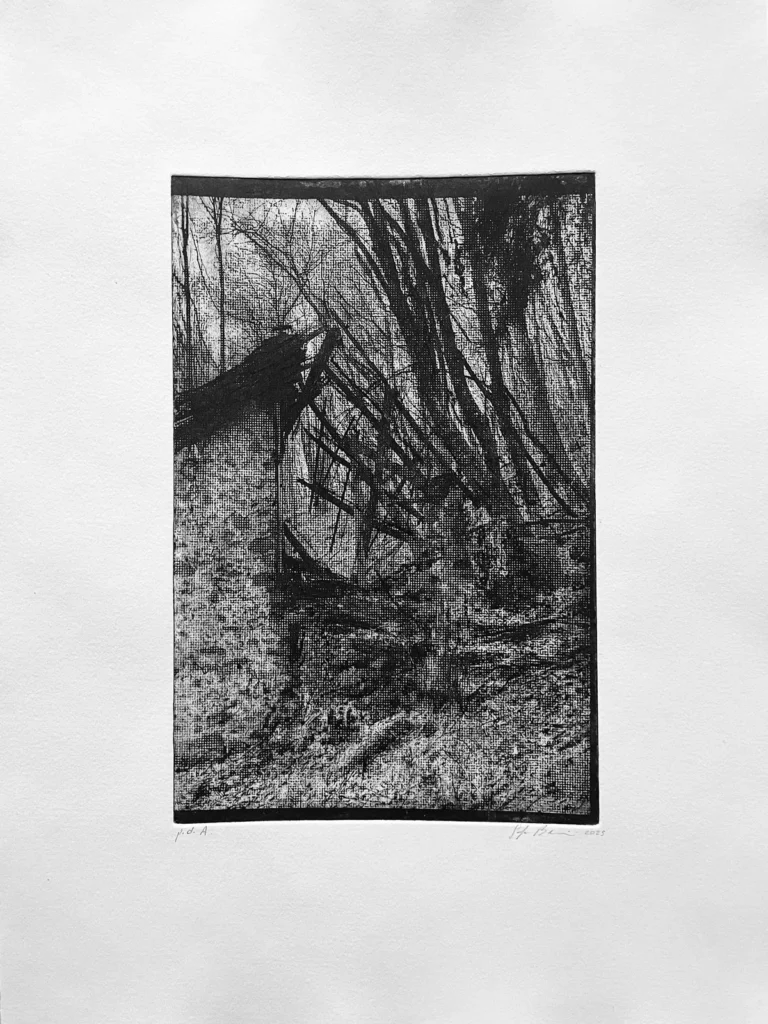
Il tetto mi è sembrato il cielo, 2026
Etching · 50 × 35 cm
13 / 18Sofia Berzoini
/The work
/The artist
I am currently on the two-year master’s course in Printmaking at the Brera Academy of Fine Arts in Milan, where I also took my bachelor’s degree.
The working process matters a great deal to me: it lets me play with the ambivalence of words and materials. Words don’t come to me; only by making can I think.
I like to keep things, to hold on to the superfluous, to what is left over.
Etching and printmaking allow this manifold, branching way of thinking, thanks to a scientific study of the elements, a rhythmic sequence and a vast range of expressive marks. The process opens up a moment in which you can feel yourself and happen at the same time.
/About the work
I am fascinated by the way a halftone screen plays on sight depending on how close we are: we draw near to that diaphanous space between viewer and subject which on one side makes visible and on the other shields, veils, mediates. A condition of permanent secrecy, hidden in plain sight on a single surface.
The image shows the remains of a shelter in the woods, where dry branches have gradually taken the place of the roof boards; but thanks to the screened surface, our immersion in the image changes with our distance.
I would like to take further my study of these traces, hidden and at the same time announced, carried through filters and visual media such as the screen and the grid, transparency and opacity.
Artist’s text, translated from Italian.
14
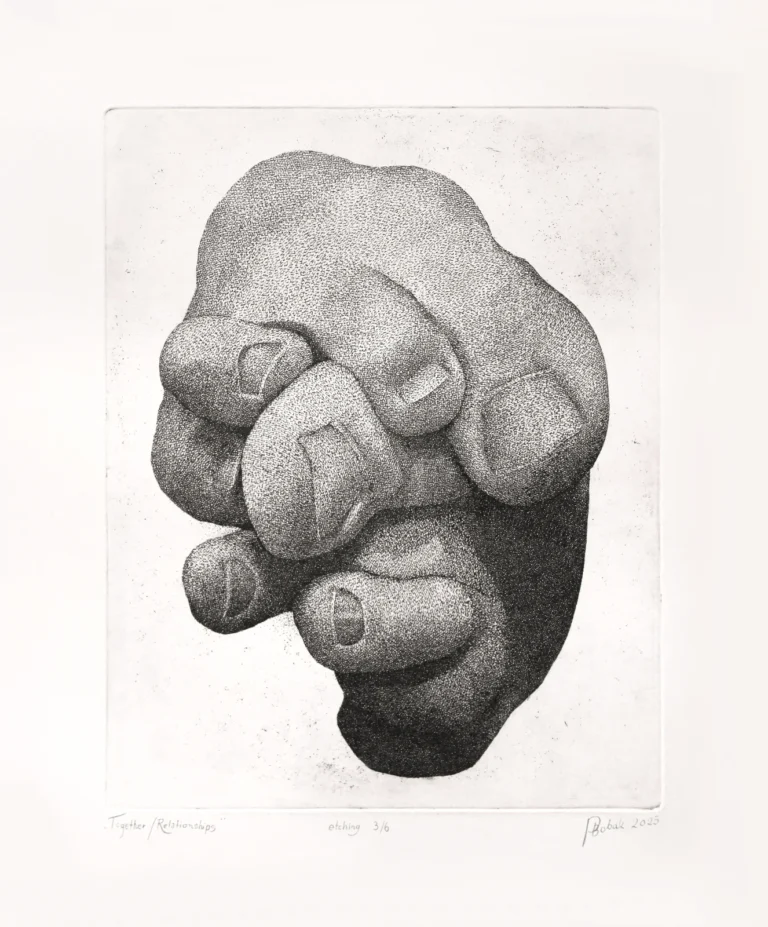
Together / Relationships, 2025
Etching · 35 × 29 cm
14 / 18Paulina Bobak
/The work
/The artist
Paulina Bobak graduated from the Graphic Art Department of the Academy of Fine Arts (2022) and completed postgraduate studies in Art History at the University of Silesia in Katowice. She is currently a PhD student at Jan Długosz University in Częstochowa. In her work she explores themes of memory and identity by analysing family archives: letters, photographs and documents. She has taken part in numerous exhibitions in Poland and abroad.
/About the work
Every memory leaves behind tiny particles in hundreds of nerve cells. Memory traces formed under the influence of specific stimuli and experiences determine human behaviour and emotions. Do the lives of our ancestors also influence who we are today? Meaning-creating gestures relate to the mental and emotional spheres; the relationships between individual body forms reflect the interdependencies between human beings.
15
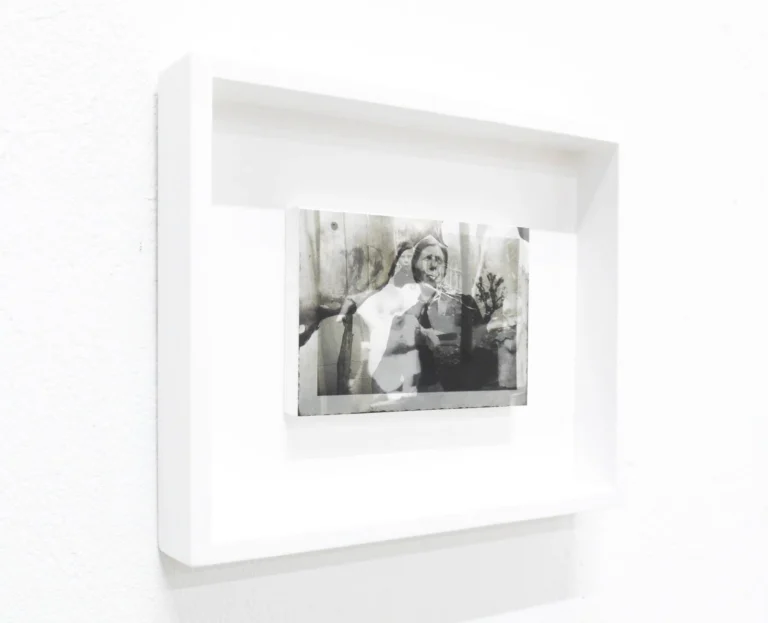
Ipotesi di Ri(de)costruzione – Senza titolo, 2023
Fine art print on Hahnemühle Photo Rag · 20.5 × 22 cm
15 / 18Matteo Trentin
/The work
/The artist
Matteo Trentin (Schio, 1996) graduated in Painting at the Brera Academy of Fine Arts and lives and works between Schio and Padua.
His research explores archives of memory, trying to bring to light the latency of memories and to retrace the places they once inhabited. Traces of family portraits or photographic landscapes are recovered here and worked on through layers of painting, installation and sound, to save them from loss while passing through it.
/About the work
I try to crystallise in a single image two archive photographs, one from my family and one anonymous, referring respectively to the beginning and the end of life.
A picture of my maternal grandmother as a newborn thus dissolves into the face of an elderly woman I never knew. This imaginative trace of memory, a synthesis of two moments so far apart yet both reaching along the cycle of existence, suggests the wish to reimagine tomorrow through the collective recovery and return of memories.
Artist’s text, translated from Italian.
16
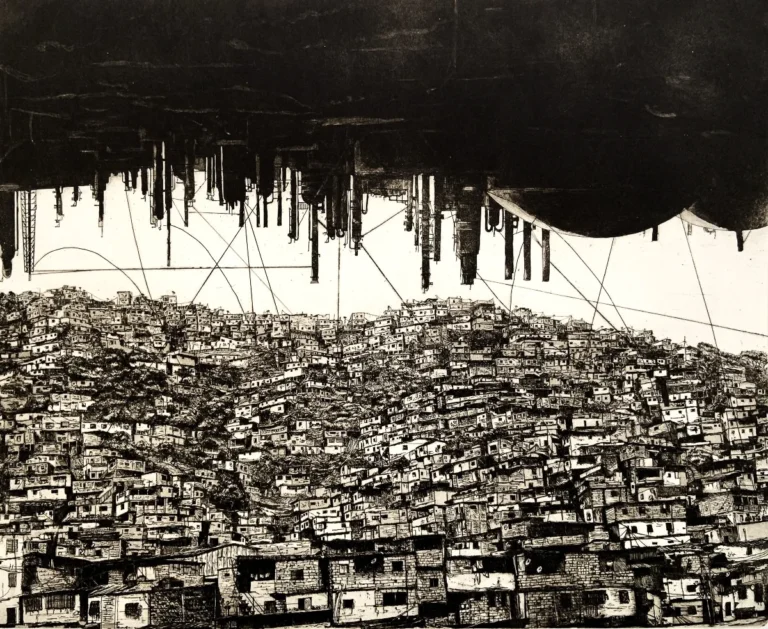
Conto alla Rovescia, 2018
Etching · 32 × 40 cm
16 / 18Pedro Luis Lava
/The work
/The artist
Pedro Lava (Venezuela, 1967) is an Italian-Venezuelan artist and printmaker, based in Italy since 1998. Trained in architecture, he perfected intaglio and relief printmaking with the masters I. Minen, L. Ceschin and G. Favaro. Winner of first prize at the 6th “Diego Donati” Printmaking Biennial in Perugia, he has exhibited in more than 15 countries at major events (the Macao Triennial, the biennials of Kraków, Varna, Douro, FIG Bilbao, Grenchen and Yerevan). His awards include prizes in Trento, Mestre and Acqui Terme. His works, reviewed in “Grafica d’Arte”, bring together memory, civic commitment and technical rigour. He is the founder of the Piave Printmakers collective.
/About the work
The work answers the theme TRACCE by telling of the indelible furrow left by Venezuela’s socio-economic crisis. Through intaglio, the act of printing a trace onto matter, it sets up a visual dialogue between the Petare favela, a symbol of extreme poverty and everyday resilience, and the Amuay refinery, an imposing oil installation shown here suspended and upside down. The mirrored composition reveals the glaring contradiction between an energy wealth that has fed corruption and the poverty afflicting millions of people. The refinery looms over the urban fabric like a countdown to social destruction. In the context of Garatelier’s opening, the work stands for the crossing between the memory of one’s origins and artistic research, turning a geographical wound into a graphic testimony of universal value.
Artist’s text, translated from Italian.
17
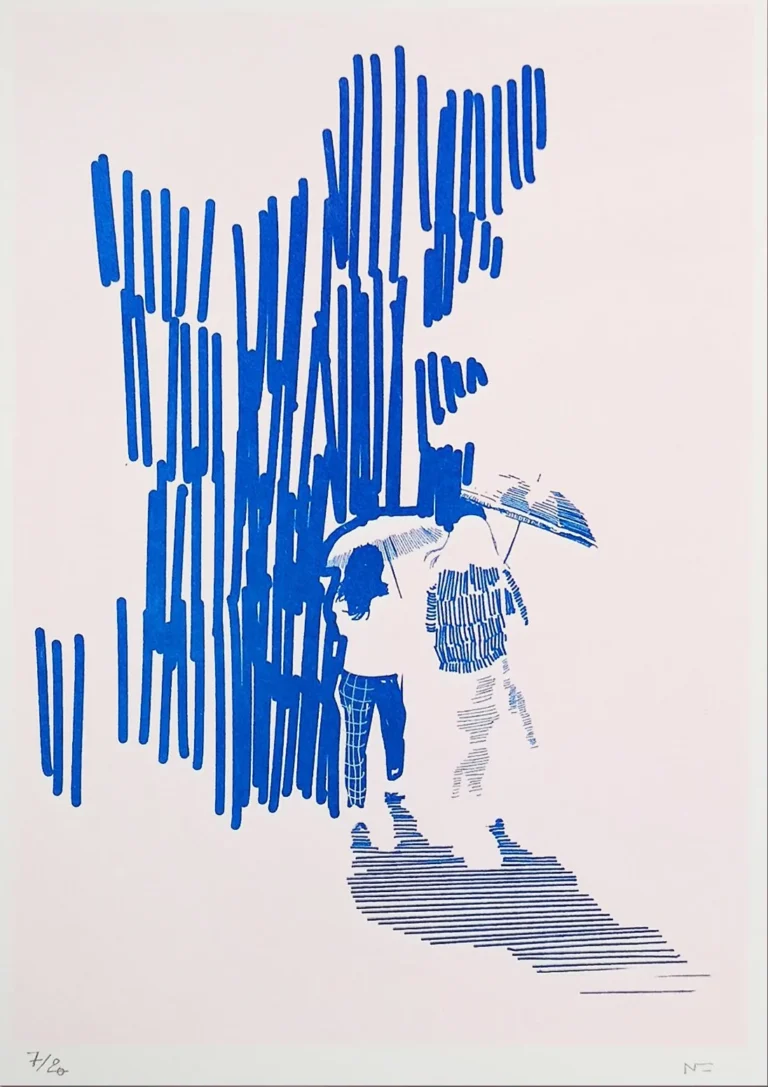
Kamakura, Fading, 2020
Risograph · 14.8 × 21 cm
17 / 18Mandy Finke
/The work
/The artist
Mandy Finke is a Luxembourgish artist based in the Netherlands. Her artistic practice is strongly influenced by a love of graphic novels and Japanese animation, drawing on traditional inking and hatching techniques and exploring the interplay between heavy contrasts and delicate linework. Her architectural background informs her approach to composition and visual storytelling, bringing together the graphic language of illustration with an attentive eye for the environments that surround us.
/About the work
This print is an attempt to capture the elusive quality of a travel memory: not a precise recollection of a place, but the fragments of atmosphere, movement and sensation that remain in your mind after returning home. The figures move through an indistinct landscape, carrying with them a trace of the place while simultaneously becoming part of it. The artwork is a trace of a trace: a physical impression of a remembered place, filtered through the artist’s experience and translated into image.
18
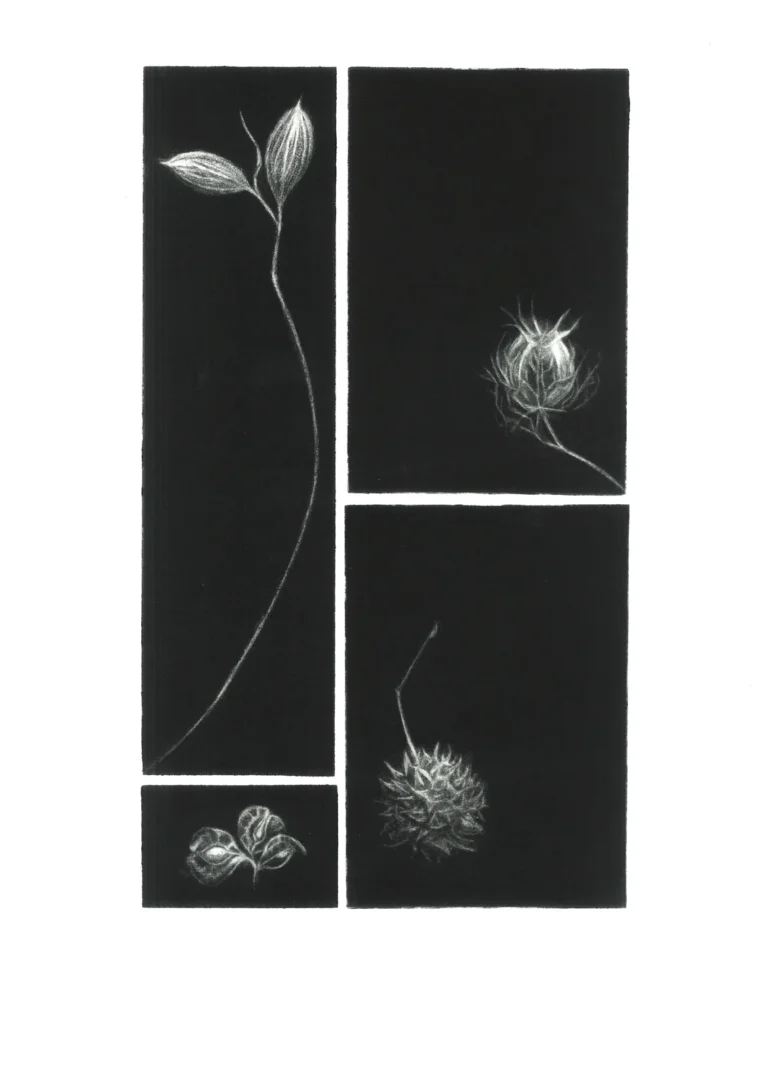
Semi, 2022
Mezzotint · 50 × 35 cm
18 / 18Valeria Iseppi
/The artist
A botanical painter since 2007 (watercolour and graphite), she has taken part in several competitions with selected and shortlisted works. She studied at the Scuola Internazionale di Grafica in Venice and at the Busato print studio in Vicenza. Some of her prints are held at the Italian Cultural Institute in Prague. Recent exhibitions: “Ellas illustan botanica” (Madrid, 2024), “La bella scienza” at the CSUV/Arte centre, Vicenza (2025), “Plantae”, SBA, London (2026).
/About the work
I gather seeds along the paths. In a small space they hold future trees.
Perhaps I have gathered a whole forest.
Artist’s text, translated from Italian.
/The opening night
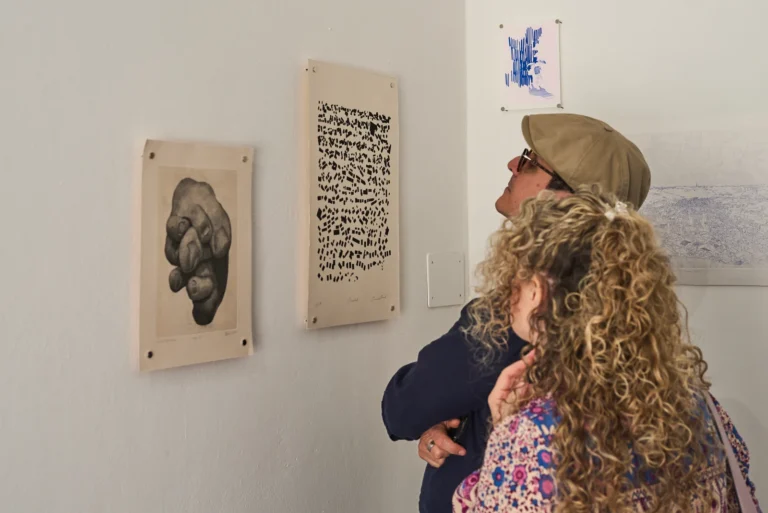
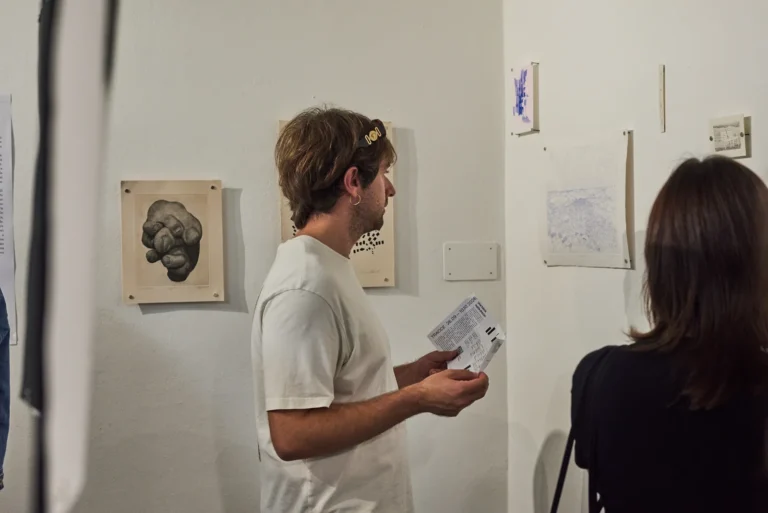
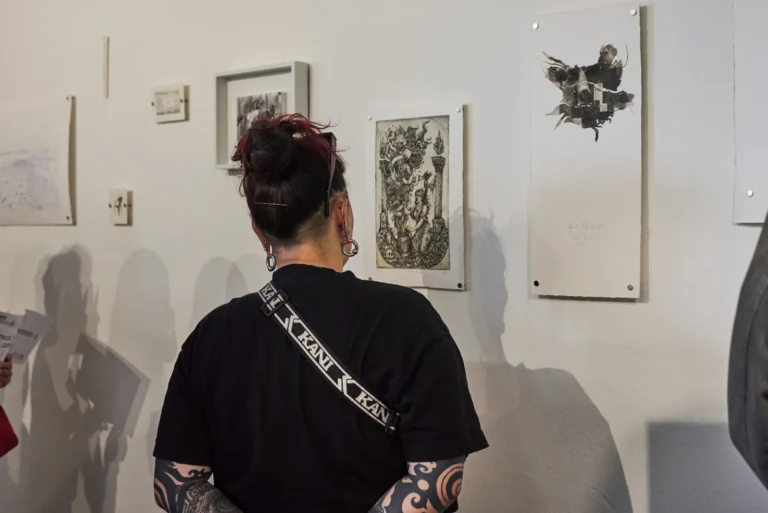
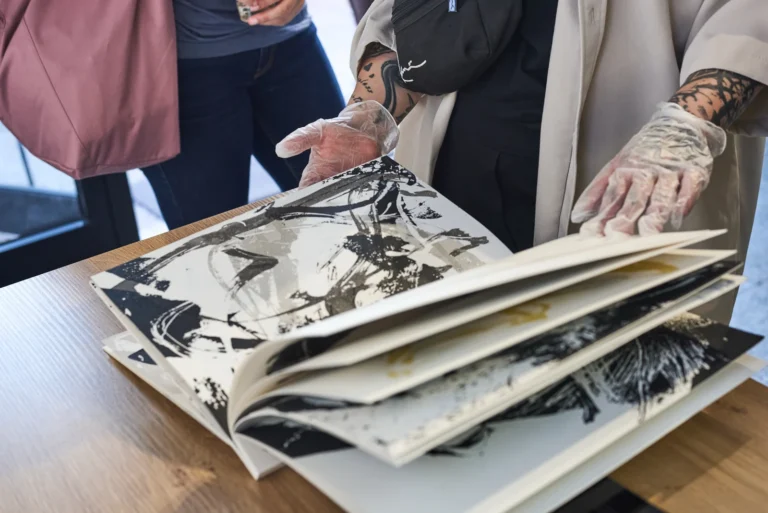
Photographs by Daniela Manfrin
/Information
Getting here